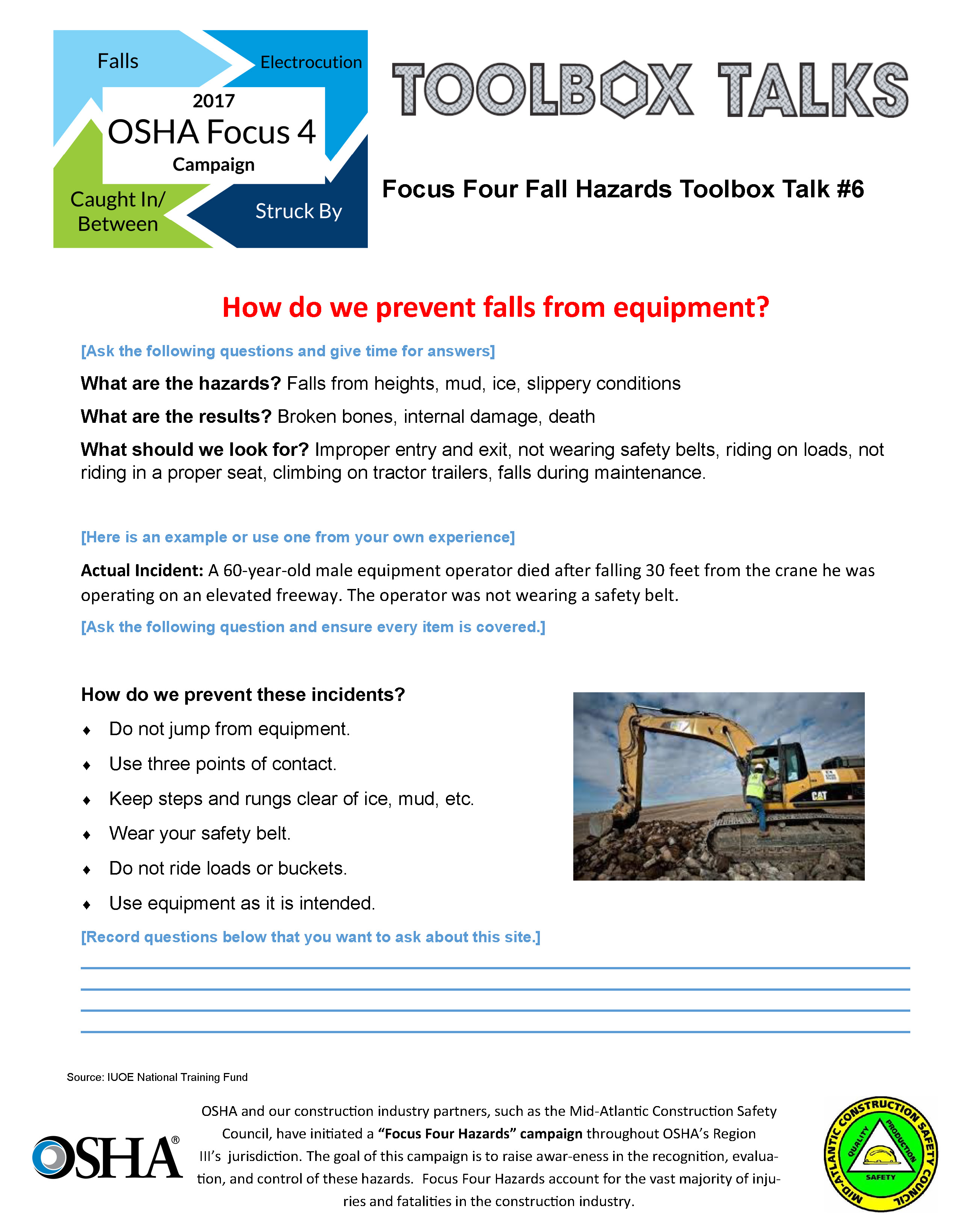
Most safety meetings fail before they start—boring slides, recycled content, and disengaged workers. But toolbox talks don’t have to be another box-ticking chore. When done right, free toolbox talk safety meeting topics can spark real conversations, expose hidden risks, and build a culture where safety is everyone’s responsibility.
The best talks are short (5–10 minutes), specific, and tied to real work happening today. They focus on one hazard, one behavior, or one task. And the good news? You don’t need a corporate training budget to run them. There are plenty of high-impact, no-cost topics that resonate with crews across industries.
Below are proven, free safety meeting topics—ready to use, customize, and deliver tomorrow.
Why Free Toolbox Talks Matter More Than Ever
Safety isn’t just about compliance. It’s about continuity. A single preventable incident can shut down a job, damage reputations, and cost lives. Yet many teams still treat toolbox talks as routine—something to document, not something to drive change.
The real power of a free toolbox talk lies in its accessibility and relevance. When workers see their own tasks reflected in the discussion, they’re more likely to speak up, act differently, and watch out for each other.
Example: A roofing crew discussing fall protection after a near-miss with a dropped tool will pay closer attention than if the same topic was delivered generically in a monthly safety seminar.
Top 10 Free Toolbox Talk Safety Meeting Topics
These topics are proven, practical, and require no special materials—just time, attention, and engagement.
1. Ladder Safety: More Than Just “Don’t Tip It”
Ladders cause thousands of injuries annually—not because people don’t know how to use them, but because they take shortcuts.
Key points to cover: - 3-point contact rule - Inspecting for cracks, loose rungs, or damaged locks - Proper angle (4:1 ratio—1 foot out for every 4 feet up) - Never overreaching or standing on the top two rungs
Real-world mistake: A painter leans too far to the side while on a step ladder, loses balance, and falls. The fall wasn’t from a great height, but resulted in a shoulder injury and 3 weeks off work.
Use this talk to reinforce that ladders are tools, not furniture.
2. Hand Safety: The
Most Common but Most Preventable Injuries
Hands are involved in nearly every task—and they’re the most frequently injured body part on job sites.
Discussion starters: - When are gloves required? (And when do they create hazards?) - Pinch points in machinery and manual handling - Avoiding “just a second” moments—like reaching into a machine without locking out
Pro tip: Bring in common tools (wrenches, knives, saws) and walk through hand placement during use. Make it visual.
3. Slip, Trip, and Fall Hazards—Even on Level Ground
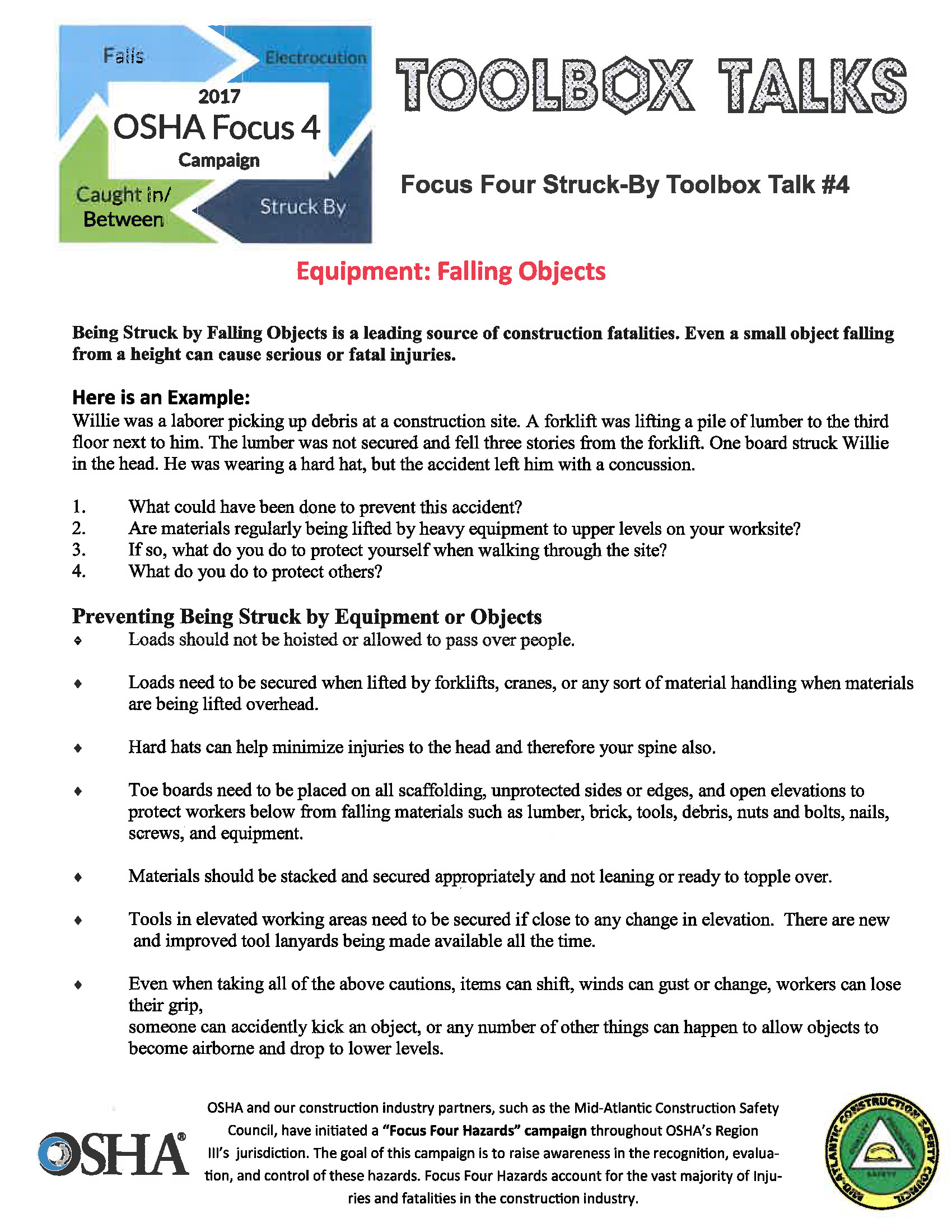
People assume falls only happen at height. But most occur on the same level—due to clutter, spills, or uneven surfaces.
Cover these points: - Housekeeping responsibilities (who cleans up?) - Proper footwear with slip-resistant soles - Awareness during high-traffic shifts or poor lighting
Use case: A utility worker slips on an oil spot near a generator. No fall, but he jerks back and strains his back. The spot had been there for hours.
This topic pairs well with a quick site walk to identify hazards on the spot.
4. Electrical Safety Around Equipment and Temporary Power
From extension cords to temporary panels, electrical hazards are everywhere—and often overlooked.
Critical reminders: - Never use damaged cords or makeshift connections - GFCI protection for all outdoor or damp locations - Keep cords off wet surfaces and away from sharp edges
Red flag: Using indoor-rated cords outside “just for a day.” Moisture intrusion can lead to shock or fire.
Discuss lockout/tagout (LOTO) briefly if working near powered systems.
5. Eye and Face Protection: One Particle Can Change Everything
Debris, chemicals, and flying fragments injure eyes daily. Yet workers often skip protection for “quick tasks.”
Focus areas: - Choosing the right PPE: safety glasses vs. goggles vs. face shields - Ensuring proper fit and maintenance - Emergency response: where’s the eyewash station?
Story to share: A welder removes his helmet briefly to inspect a joint. A spark hits his eye. He’s okay—but now wears goggles even during inspection.
Make it personal. It works.
6. Working in Confined Spaces—Even Small Ones
Not all confined spaces are tanks or vaults. A crawl space, utility pit, or even a large pipe can qualify—and bring serious risks.
Talk about: - Testing air quality before entry - Having a spotter outside - Emergency retrieval plans
Common mistake: Assuming “I’ll just duck in for a minute” is safe. Time doesn’t reduce risk.
7. Hearing Protection and Noise Awareness
Long-term hearing damage is silent—until it’s not.
Key points: - Identify high-noise zones (jackhammers, saws, compressors) - Proper fit of earplugs or muffs - Signs of fatigue or ringing after shifts
Practical tip: Use a decibel meter app on a phone to measure actual noise levels during the talk. Makes it real.
8. Proper Lifting Techniques—It’s Not Just Backs
Safe lifting protects backs, shoulders, and knees.
Cover: - Bend knees, keep back straight - Keep load close to body - Use mechanical aids when possible - Team lifting: communicate first
Mistake to avoid: Twisting while lifting—even with “good form.” Rotation multiplies injury risk.
9. Weather-Related Hazards (Heat, Cold, Rain)
Weather changes fast—and so do the risks.
Heat stress talk points: - Recognizing early signs: headache, nausea, dizziness - Hydration: water every 15–20 minutes, even if not thirsty - Rest breaks in shade or cool zones
Cold weather focus: - Layering clothing, keeping extremities warm - Watch for numbness or shivering
Rain impact: Slippery surfaces, electrical risks, reduced visibility.
Update this talk seasonally.
10. Near-Miss Reporting: Why Silence Is Dangerous
Most incidents are preceded by near-misses. But if workers don’t report them, patterns go unseen.
Break the stigma: - Reporting isn’t blaming - A near-miss is a free warning - Use real (anonymous) examples from your site
Ask this question: “Who had a close call this week? What did we learn?”
This topic builds trust and normalizes speaking up.
How to Run Better Free Toolbox Talks
Having good topics isn’t enough. Delivery matters.
Structure That Works:
- Start with a question or story
- “Last week, a crew in Texas avoided a fall because someone spoke up. What would you have done?”
- Focus on one hazard
- Don’t cover 5 topics in 10 minutes. Go deep on one.
- Engage the crew
- Ask for input: “Where do you see this risk on our site?”
- End with action
- “Today, check your ladders before use. Report any damage.”
- Document briefly
- Name, date, topic, attendees. No essays.
Common Mistakes That Kill Engagement
Even with free, solid topics, these errors sabotage impact:
- Reading from a script – Sounds robotic. Use bullet points, not paragraphs.
- Ignoring the current site conditions – Talking about snow removal in July feels irrelevant.
- No follow-up – If you don’t act on feedback, people stop participating.
- Same person every time – Rotate facilitators. Fresh voices keep interest alive.
- Skipping because “nothing’s wrong” – Proactive talks prevent problems.
Customizing Free Topics for Your Team Generic topics work, but tailored ones stick.
Ways to customize: - Add site-specific photos (e.g., a ladder used yesterday) - Reference recent incidents, even minor ones - Invite crew leaders to lead a talk on their specialty - Translate into primary languages spoken on site
Example: A crew working on scaffolding gets a talk focused on plank stability, guardrail checks, and tool tethering—not a generic fall protection script.
Where to Find Reliable Free Resources
You don’t need to create everything from scratch.
- Trusted sources for free toolbox talk topics:
- OSHA.gov – Offers topic guides, fact sheets, and hazard alerts.
- NIOSH (CDC) – Science-backed resources on respiratory, noise, and ergonomic risks.
- Safety + Health Magazine (NSC) – Practical, plain-language talks.
- CPWR – The Center for Construction Research and Training – Construction-specific toolkits.
- WorkSafeBC – Free downloadable templates, even for remote sites.
All are free, regularly updated, and designed for real-world use.
Turn Safety Talks Into Safety Habits
Free toolbox talk safety meeting topics aren’t about checking a compliance box. They’re about shaping behavior.
When workers start reminding each other to wear gloves or point out a tripping hazard unprompted, you’ve won. That’s culture change.
Start tomorrow. Pick one topic. Gather your crew. Ask a question. Listen. Act.
The best safety meetings don’t end when the talk does—they echo through the rest of the shift.
FAQ
What should you look for in Free Toolbox Talk Safety Meeting Topics for Any Job Site? Focus on relevance, practical value, and how well the solution matches real user intent.
Is Free Toolbox Talk Safety Meeting Topics for Any Job Site suitable for beginners? That depends on the workflow, but a clear step-by-step approach usually makes it easier to start.
How do you compare options around Free Toolbox Talk Safety Meeting Topics for Any Job Site? Compare features, trust signals, limitations, pricing, and ease of implementation.
What mistakes should you avoid? Avoid generic choices, weak validation, and decisions based only on marketing claims.
What is the next best step? Shortlist the most relevant options, validate them quickly, and refine from real-world results.